In a completed phase II clinical study (NCT05764590), AP306 monotherapy significantly reduced serum phosphorus in patients with hemodialysis and hyperphosphatemia and significantly improved serum phosphorus control. AP306 has been proven to be safe and well-tolerated.
Repon Pharma is actively advancing further clinical development of AP306.
May 27, 2024— Shanghai, China – Libon Pharma ("Libon or the Company"), a comprehensive biopharmaceutical company focused on developing innovative drugs for the treatment of kidney diseases and related chronic diseases, announced the results of its Phase II clinical study of AP306 in patients with hemodialysis and hyperphosphatemia in a Focused Oral presentation at the 61st Annual Meeting of the European Society of Kidney (ERA) in Stockholm, Sweden, on May 24.
AP306 is a first-in-class sodium-dependent phosphate transporter pan-inhibitor that blocks active intestinal phosphate transport and is expected to overcome the limitations of low-phosphorus diets and phosphorus binders for hyperphosphatemia. The reported study is a randomized, open-label, positive drug-controlled phase II clinical trial, led by Professor Wang Li of Sichuan Provincial People's Hospital, and completed in 11 research centers in China.
In this phase II clinical study:
Fifty-five patients on hemodialysis with hyperphosphatemia were randomized to receive AP306 (N=27) and sevelamer carbonate (N=28) for 12 weeks. Adjust the dose of AP306 and sevelamer carbonate every 4 weeks to keep serum phosphorus controlled within the target range of 3.5–5.5 mg/dL. The trial dose of AP306 begins at 75 mg three times a day and gradually increases to 125 mg and 150 mg three times a day with meals.
Both groups achieved statistically significant decreases in the primary efficacy endpoint, i.e., the change in serum phosphorus mean from baseline to the end of treatment, at -2.51 mg/dL (95% CI: -3.07, -1.92) in the AP306 group and -1.08 mg/dL (95% CI: -1.58, -0.59) in the sevelam carbonate group (see Table 1), and the decrease in serum phosphorus in the AP306 group was significantly higher than that in the sevelam carbonate group.
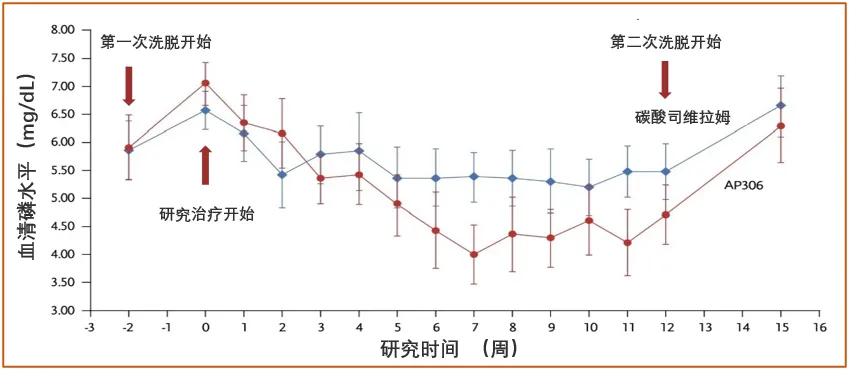
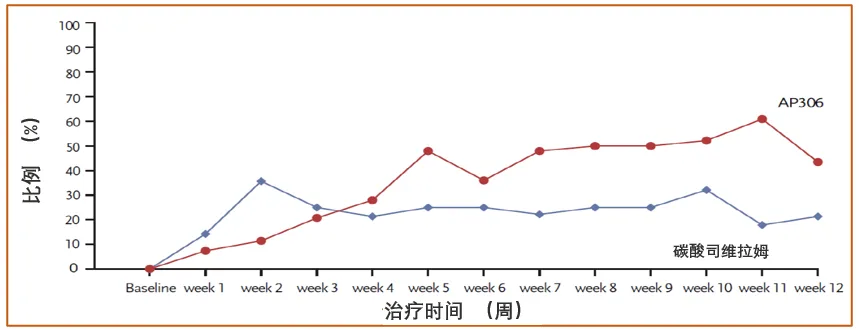
During treatment, serum phosphorus averages in the AP306 group decreased with prolongation of treatment, starting at the end of the third week and continuing below the sevelamer carbonate group until the end of treatment (see Figure 1). While the proportion of patients who met the study-defined serum phosphorus target range (3.5 – 5.5 mg/dL) was comparable between the two groups, the proportion of patients who met the serum phosphorus target range recommended by KDIGO (2.5 – 4.5 mg/dL) was significantly higher in the AP306 group than in the sevelam carbonate group (see Figure 2).
During the last 4 weeks of treatment, the average daily dose in the AP306 group was lower than that of sevelamer carbonate at 288.30 mg/day and 4650.99 mg/day, respectively.
The most common adverse events in the AP306 group were gastrointestinal reactions (51.9%), mainly diarrhea (44.4%). All diarrheal events are grade 1/2 in severity and most resolve spontaneously within 2 weeks. No serious adverse events were reported in the AP306 group.
Dr. Tian Jin, Co-Founder and Chief Medical Officer of Repon Pharma, said, "The data from the AP306 proof-of-concept study are encouraging, and AP306 treatment has the potential to significantly improve blood phosphorus control in patients on dialysis with hyperphosphatemia. "Lipon will continue to advance the clinical development of AP306 globally.
Information from the 61st Congress of the European Kidney Association
When: Friday, May 24, 2024
Title: A phase II trial to evaluate the effect of the phosphate transporter pan-inhibitor AP306 in reducing serum phosphorus in patients with hyperphosphatemia on dialysis
Table 1 Primary efficacy endpoint: Change in serum phosphorus from baseline to end of treatment
CI – confidence interval; EOT – end of treatment; LCL – lower limit of confidence interval; Mean – Average; N–Number of patients; SD – standard deviation; UCL – upper confidence interval
Figure 1 Change in serum phosphorus over time during the study
Figure 2 Proportion of patients with serum phosphorus between 2.5 – 4.5 mg/dL


 简体中文
 English
 繁體中文